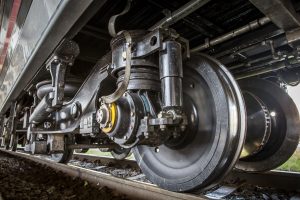
So far in our System Thinking series, we’ve focused largely on the infrastructure side of the Wheel Rail Interface. For the third part of the series ahead of InnoTrans 2026, we’re moving onto the wheel and the role onboard lubrication can play in managing wheel flange wear.
For operators looking at onboard wheel flange lubrication, one of the decisions is whether to use a spray system or solid stick lubrication. Both apply lubricant directly from the vehicle, but the way they operate and the maintenance they require are very different.
There isn’t a simple answer as to which is better. The right approach depends on the rolling stock, how and where it’s operating and what the operator needs from the lubrication system over the life of the fleet.
When Does Spray Wheel Flange Lubrication Make Sense?
Spray systems apply grease directly to the wheel flange using onboard equipment. This gives operators control over the amount of lubricant being delivered and allows the system to be set up around the operating requirements of the vehicle.
RS Clare’s ClareShield Onboard 000 has been developed specifically for onboard wheel flange lubricators. The grease forms a stable gel that helps it remain on the wheel flange, while maintaining a consistent spray pattern and volume across different operating temperatures. It has also been tested and approved for use with equipment from OEMs including REBS and Bijur Delimon.
This makes spray lubrication particularly relevant where the lubrication system is already integrated into the rolling stock or where an operator wants greater control over how lubricant is applied. RS Clare identifies metro and tram systems as particularly suitable applications for ClareShield Onboard 000.
A spray system introduces pumps, pipework and other components that need to remain operational for the lubricant to reach the flange consistently. For fleets with established onboard systems and suitable maintenance access, that can be managed as part of the vehicle’s existing maintenance programme.
Where Does Solid Stick Lubrication Fit In?
Solid stick lubrication takes a different approach. Rather than pumping grease through an onboard system, the stick is held against the wheel flange using a spring-loaded applicator. The material transfers from the wheel to the rail, creating a lubricating film at the contact point.
The simplicity of the system is one of its main advantages. RS Clare’s ClareShield EcoStick WFS system is mounted directly to the bogie and is designed to be easily accessible for maintenance, with stick changes completed without the need for trackside access.
Consumption becomes particularly important for fleets covering high mileages. A stick that wears quickly needs replacing more frequently, adding to both product use and maintenance requirements.
This is an area where EcoStick WFS has shown a significant difference in testing. It typically reduces stick consumption by 40% – 60% or more compared with competitor wheel flange sticks. In a back-to-back trial on a European urban railway over 35,000 km, a competitor stick was consumed three times as quickly as EcoStick WFS, with no difference in wheel wear during the test period.
For a high-mileage fleet, extending the time between stick changes can make a meaningful difference to the amount of maintenance required over the life of the system.
Passenger or Freight?
The type of rolling stock and the way it’s used also influence the decision between spray and stick lubrication.
A passenger fleet operating frequent services may already have onboard spray equipment integrated into the vehicle, making a suitable spray lubricant the natural choice. ClareShield Onboard 000, for example, has been developed with metro and tram applications in mind and provides wear protection under high-load conditions.
Solid stick systems offer much broader flexibility across rolling stock. EcoStick WFS can be used across passenger and freight trains, locomotives, metro and commuter lines, as well as other rail applications. It also works with most current stick application systems.
That flexibility can be particularly useful when looking at retrofit. Operators don’t necessarily need a complex lubrication system to introduce wheel flange lubrication to an existing fleet. A solid stick system uses the lubricant, a spring-loaded applicator and a holding bracket mounted at the wheel, making it a relatively straightforward system to maintain.
For new rolling stock, the decision can be made much earlier. Lubrication requirements can be considered alongside the vehicle design and maintenance strategy, rather than finding a solution that needs to work around an existing setup.
What About Curved Track?
Wheel flange lubrication becomes particularly important where fleets operate over routes with a high proportion of curved track. Increased flange contact through curves creates greater demand at the Wheel Rail Interface, making consistent lubrication important for managing wear.
This is where looking beyond the lubricant itself becomes important. A fleet covering long distances or regularly travelling through curved sections needs a system that can continue providing effective lubrication without creating an unrealistic maintenance burden.
For a spray system, that means considering lubricant consumption alongside the reliability and accessibility of the onboard equipment. With a stick system, consumption rate and replenishment intervals become particularly important. Neither should be looked at purely in terms of the lubricant being applied.
Choosing the Right Approach for the Fleet
Choosing between spray and stick lubrication ultimately comes down to how the fleet operates and how the lubrication system will be maintained.
An existing onboard spray system may make a spray lubricant the obvious choice. For another fleet, the simplicity of a stick system and longer replenishment intervals may make more sense, particularly where maintenance accessibility is a priority.
This is another example of RS Clare’s System Thinking approach to the Wheel Rail Interface. The decision isn’t simply spray or stick. It’s about understanding the rolling stock, its operating environment and how the lubrication system will perform throughout its working life.
At InnoTrans 2026, RS Clare will be showcasing ClareShield Onboard 000 and ClareShield EcoStick WFS as part of its wider Wheel Rail Interface offering, giving operators the opportunity to compare the different approaches and discuss which is better suited to their fleet.
In the next blog in our System Thinking series, we’ll look more closely at wheel flange lubrication and how the right solution can help reduce wheel wear and whole-life maintenance requirements.